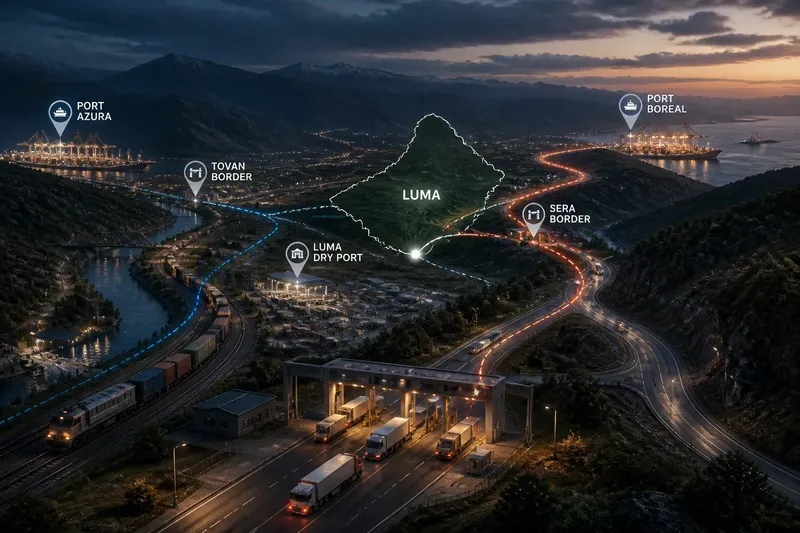
A Household Object’s Long Journey: Sketching a Supply Chain
Sketching a household object’s supply chain shows how raw inputs become a finished good and helps you trace its places, processes and uncertainties.
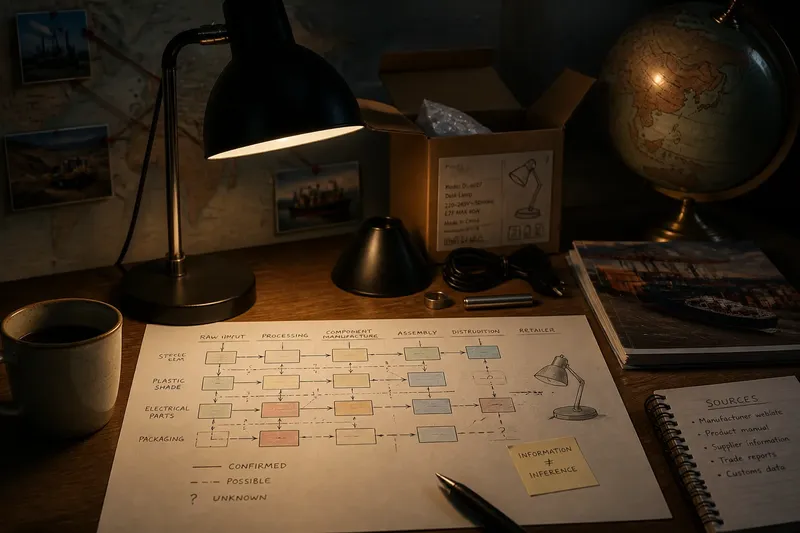
Where did the materials in your kettle, mug or desk lamp come from, and how did they reach the shop? Sketching a household object’s supply chain gives you a way to investigate that journey without pretending every product follows the same route. The aim is a useful map of stages, places and connections, not a claim that you can uncover every supplier from a label.
Choose one ordinary manufactured object and follow its components backwards from the point of sale, then forwards from raw inputs towards distribution. A kettle, for instance, may combine metal, plastic, an electrical element, a cord and packaging, each with a different path. The finished object can therefore have several supply chains meeting at assembly.
A week for tracing
A week is a manageable period for a first sketch. Set aside a short session each day, keep one page or digital document for notes, and mark uncertain information plainly. You are building a provisional picture that can be revised, not completing an audit.
- Day one: Choose an object and record its maker, model, country-of-origin wording and any material details on the packaging or product page.
- Day two: Break it into major components and identify likely material categories.
- Day three: Trace the materials to their first processing stages and note what remains unknown.
- Day four: Look for where components are made and where the object is assembled.
- Day five: Sketch the likely distribution route from assembly to retailer.
- Day six: Check the links against manufacturer information, trade descriptions and other credible public sources.
- Day seven: Redraw the map, separating confirmed details from reasonable possibilities.
This is a routine, not a required timetable: combine sessions if you have time, or stretch them out if sources are hard to find. If you meet a dead end, write down the missing link and move to the next component rather than filling the gap with a confident guess.
Choose a traceable object
Pick something familiar with visible components and enough identifying information to search. A plain ceramic mug may have a relatively simple materials story, while a desk lamp can reveal how metals, plastics, electrical parts and packaging converge. Avoid beginning with an object whose maker and model are difficult to identify.
Record what you can see before searching: product name, model code, material labels, maker, retailer and country-of-origin statement. Keep the wording exact. “Made in” may tell you something about the product’s origin under applicable rules, but it does not by itself disclose where every input was extracted or processed.
Say you choose a desk lamp with a steel stem, plastic shade and packaged electrical parts. You note the label and model, then search the maker’s product information for component materials and assembly details. If the maker identifies an assembly country but not the source of the steel, the expected result is a map with a located assembly stage and an explicitly unresolved material origin—not an invented mine.
Separate the material stages
For each major component, work backwards through distinct stages. “Steel” is not a place or a complete account of its origin: iron ore and other inputs may be extracted in one region, converted into metal elsewhere, formed into a stem at another plant and then sent to assembly. Treat each transformation as a separate box.
Use broad categories where specifics are unavailable:
- Raw input: a mineral, plant-based material, fossil-derived feedstock or other starting resource.
- Processing: refining, smelting, milling, chemical conversion or another operation that changes the input.
- Component manufacture: shaping or combining processed materials into a part, such as a shade, wire or fastener.
- Assembly: joining components into the finished object and preparing it for sale.
- Distribution: moving the packaged object through a warehouse, wholesaler or retailer to its destination.
These categories help prevent a common mix-up: the place where a finished object is assembled is not necessarily the place where its materials originated. Some chains involve several processing sites; others are more concentrated. Your sketch should show the route you can support and leave room for alternatives.
Find places and connections
Search in layers. Start with the maker’s product page, packaging and corporate supply-chain disclosures. Then look for component descriptions, manufacturing statements and public information from relevant trade bodies or customs agencies. A retailer’s listing can help identify a model, but it may simply repeat the maker’s wording.
Write down the source beside each claim and note its scope. A statement about a company’s general sourcing policy is not proof that a particular kettle uses material from a particular country. Likewise, a shipment route reported for one consignment should not be treated as the standard route for every unit.
On the sketch, use arrows to show the movement of materials or components and label each arrow with a transport mode only when you have support for it. A route may involve road, rail, sea or air, but do not infer a specific port or border crossing from a country name alone. The point is to show connections, not to draw a detailed transport map without evidence.
Keep the geography legible. Use country names for broad locations; add a city or industrial region only when a source identifies it. If the available information gives several possible sites, show them as alternatives or a range of possibilities rather than choosing one for neatness.
Mark what remains uncertain
A strong supply-chain sketch distinguishes information from inference. Use a solid line for a link directly supported by a source, a dashed line for a plausible but unconfirmed connection, and a question mark where you cannot identify the next stage. Add a short note explaining why the link is uncertain.
This matters because supply chains are often commercially sensitive and can change as firms choose suppliers, contracts or production sites. Public descriptions may also refer to a product family rather than your exact model. Do not turn a general statement into a precise claim about the object in your hand.
Imagine the lamp maker says the product is assembled in one country and its supplier lists a plastic shade made in another, but neither source identifies the resin’s origin. Your map can show the two known stages and a dashed line from the shade to an unspecified resin processor. That visible gap is more informative than a guessed country presented as fact.
Use a small legend and a date for when you checked the information. This signals that the drawing is a snapshot, not a permanent description. If sources conflict, record both claims and their dates, then avoid resolving the disagreement unless there is clear evidence to do so.
What can a supply-chain sketch tell you?
Does the label reveal the whole route?
No. A label may identify the maker, materials or a legally relevant country of origin, but it usually does not list every extraction, processing and component-making location. Treat it as a starting point for research, not a complete chain.
How should I handle several suppliers?
Draw branches from the stage where sources diverge, such as separate inputs feeding a metal component or multiple component makers supplying an assembler. If the actual supplier is unknown, label the branch as possible rather than assigning the product to a named firm.
What if sources disagree?
Keep both statements with their source and date, and note whether they refer to different models, production periods or levels of the supply chain. If the difference cannot be explained, leave the location unresolved instead of selecting the more convenient account.
When is the map complete?
It is useful when it shows the object’s main stages, the places you can support, the connections between them and the gaps that remain. A complete account may not be publicly available, so define the end of your work as a clear, honest sketch rather than total knowledge.
Turn the sketch into a clear map
Arrange the boxes from left to right, beginning with raw inputs and ending with the retailer or user. Put components on separate rows where their paths differ, then join them at assembly. Add a small note for packaging if it has a separate material story worth tracing.
Think of the drawing as a row of labelled trays: each tray holds one stage, and arrows show which items move to the next. The analogy is deliberately simple; real supply chains branch, split and sometimes circle through recycling or reprocessing, so use extra arrows rather than forcing every route into a single line.
Keep each label short and put detail in notes below the map. For example, a box might read “plastic shade formed — location reported by maker”, while a note gives the source and the limitation. This makes the map readable without hiding how each claim was reached.
Before sharing it, check that every place name has a source, each arrow represents a plausible connection, and uncertain stages are visibly marked. Remove any detail that depends only on assumption, or change its line style and label it accordingly. A reader should be able to tell at a glance which parts are documented and which need further information.
Use the map carefully
A supply-chain sketch can clarify how global connections bring materials, components and finished goods together. It can also show why a product’s country-of-origin label does not describe every place involved. The map is most valuable when it makes those distinctions visible.
Use your household object’s supply chain to ask focused questions: which stage is documented, which source supports it, and what connection remains unknown? When new information appears, update the relevant box rather than redrawing the whole story as though it had always been certain.
For a first attempt, one object and a handful of well-labelled stages are enough to make a useful map. Keep the unresolved links on the page: in international trade, an honest blank is not a failure of the sketch but a precise account of what the available evidence cannot yet tell you.